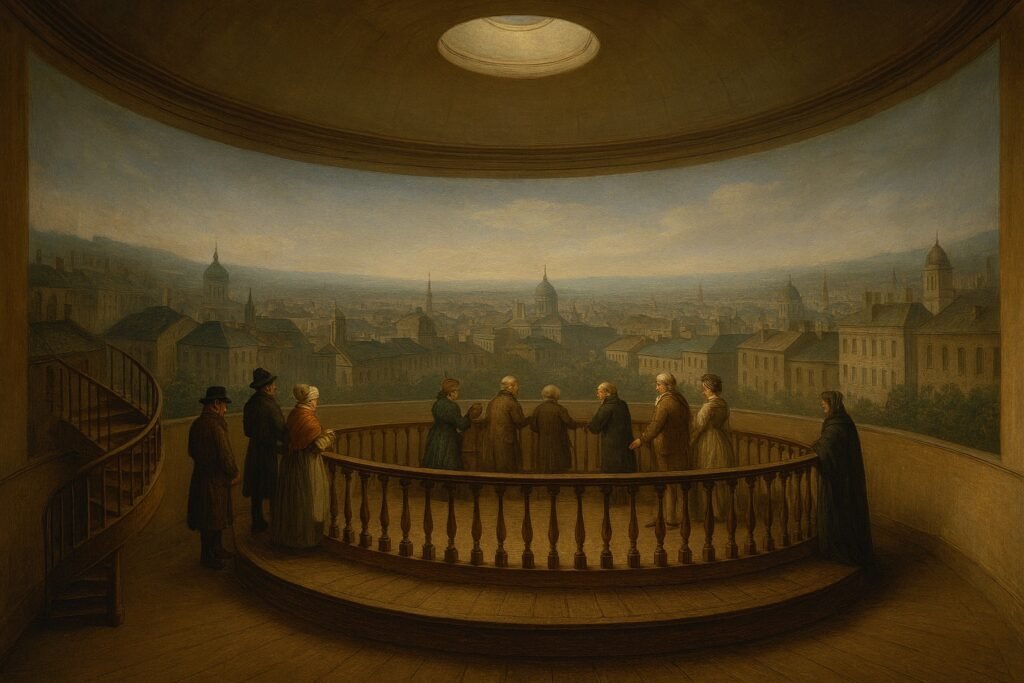
The panorama was born not as a camera technique, but as an immersive way of seeing—a cultural invention that reshaped how people experienced place, scale, and storytelling. Long before wide‑format lenses or stitched digital images, Robert Barker’s 18th‑century Rotunda introduced audiences to a new visual world: a seamless, 360‑degree environment that surrounded the viewer and dissolved the edges of ordinary perception. This post explores how Barker’s vision sparked the panoramic tradition, how the Rotunda changed visual culture, and why this early innovation still echoes through modern photography and panoramic art.
The World That Inspired the First Panorama
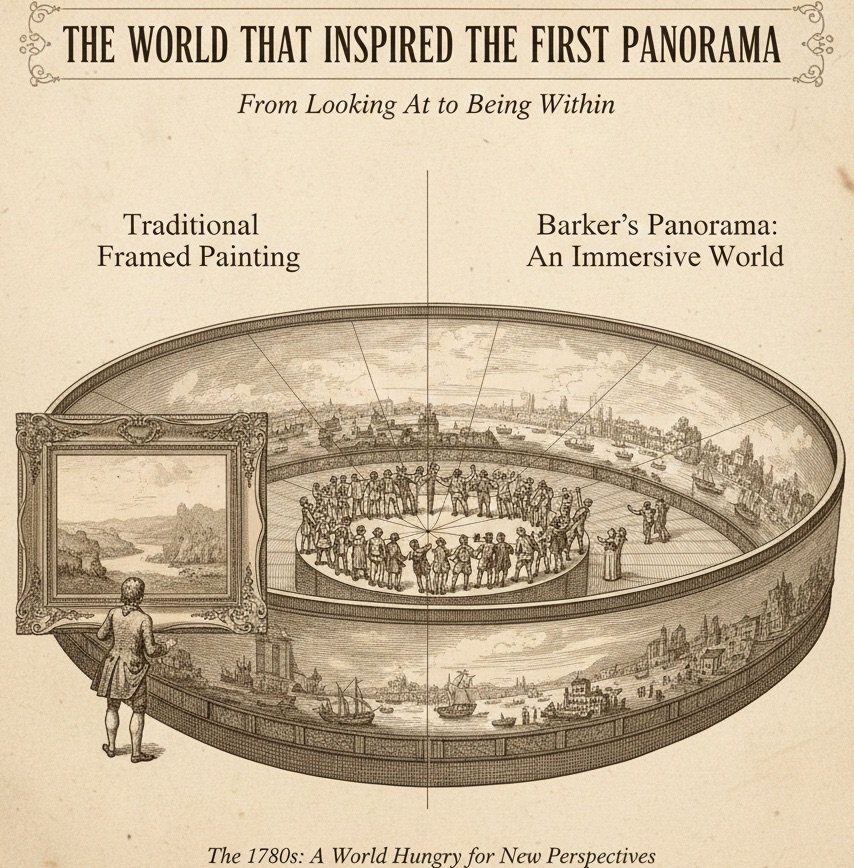
When Robert Barker coined the word panorama in the 1780s, he lived in a rapidly changing world. Cities were expanding, travel was accelerating, and people were hungry for new ways to understand distant landscapes and historic events. Barker recognized that traditional paintings—framed, flat, and limited—couldn’t capture the full sweep of a place. He wanted viewers to feel inside the scene, not merely looking at it.
His idea was radical: a circular painting that wrapped around the viewer, eliminating the frame entirely. Instead of a window onto a scene, the panorama became a world unto itself.
This shift in perception—moving from looking at an image to being within it—laid the foundation for every panoramic technique that followed, from cylindrical photography to immersive VR environments.
Robert Barker’s Vision and the Birth of the Rotunda



Barker patented his invention in 1787, describing it as a “picture without boundaries.” To display it properly, he needed a new kind of building—one that could hold a massive cylindrical canvas and control the viewer’s perspective. The result was the Rotunda, a purpose‑built structure in Leicester Square that opened in 1793.
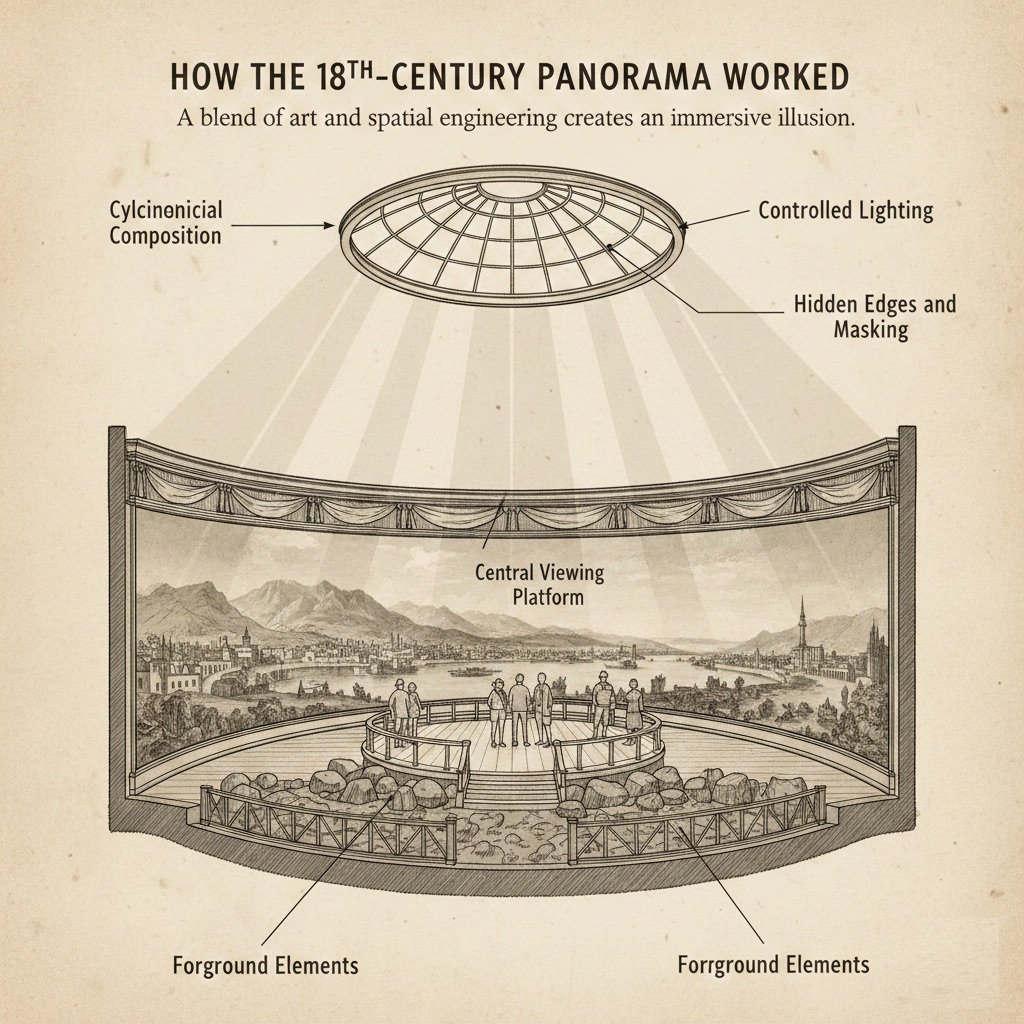
Inside the Rotunda, visitors climbed a central staircase to a raised viewing platform. From there, the painting surrounded them in every direction. Carefully controlled lighting, architectural masking, and foreground props created the illusion of depth and realism. The effect was astonishing for its time: people felt transported.
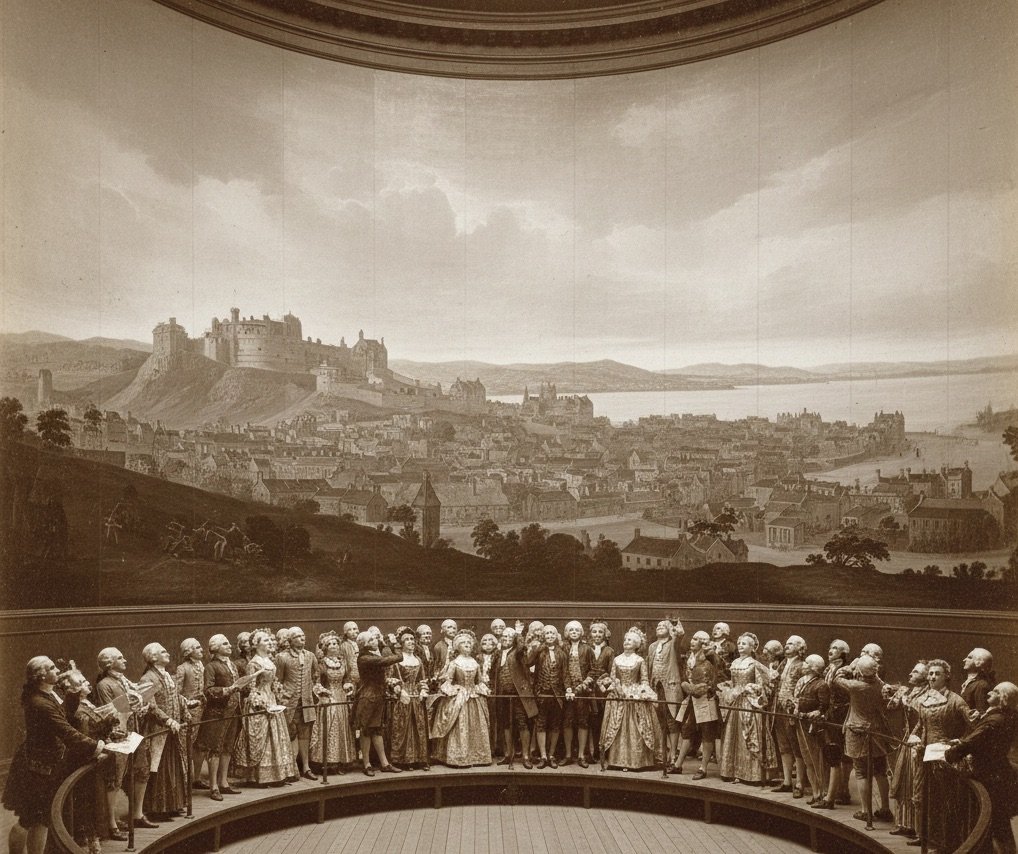
The Rotunda became a cultural phenomenon. Crowds lined up to see panoramic views of Edinburgh, London, Constantinople, and naval battles. Barker’s invention blended art, architecture, and spectacle—an early form of immersive media that anticipated everything from IMAX theaters to digital 360° photography.
How the 18th‑Century Panorama Worked
The success of Barker’s panoramas depended on a combination of artistic technique and spatial engineering. Several key elements defined the experience:
- Cylindrical Composition — The painting wrapped around the viewer, requiring artists to understand perspective in a continuous, unbroken format.
- Central Viewing Platform — Elevation ensured that the horizon line aligned naturally with the viewer’s eye level.
- Hidden Edges and Masking — Architectural elements concealed the top and bottom of the canvas, preventing visual breaks.
- Controlled Lighting — Skylights and diffused illumination created even lighting across the entire scene.
- Foreground Elements — Rocks, railings, or props extended the illusion into the viewer’s space.
These techniques created a seamless environment—an early form of immersive storytelling that relied on spatial awareness, atmospheric detail, and the psychology of perception.
The Panorama as Cultural Technology
Barker’s panoramas were more than entertainment. They shaped how people understood geography, war, travel, and urban life. In an era before photography, panoramas offered:
- A sense of presence in distant places
- A visual record of historic events
- A democratic experience accessible to the public
- A new artistic language based on scale and immersion
The Rotunda became a hub of cultural exchange, where visitors could “travel” without leaving London. This desire for immersive experience—seeing the world in its full sweep—became a defining feature of panoramic art.
From Painted Rotundas to Photographic Panoramas
The invention of photography in the 19th century transformed the panorama once again. Early photographers adapted Barker’s principles to the camera:
- Cylindrical panoramas created by rotating the camera
- Segmented panoramas stitched from multiple exposures
- Vertical panoramas capturing towering architecture and cliffs
- Full 360° images echoing the Rotunda’s immersive circle
Even today, panoramic photography carries Barker’s DNA. Whether capturing a skyline, a mountain range, or a sweeping interior, the goal remains the same: to expand the viewer’s field of vision and create a sense of presence.
Modern tools—digital stitching, wide‑angle lenses, VR capture—extend the tradition, but the core idea is unchanged. The panorama is still about immersion, scale, and the feeling of standing inside a place.
Why Barker’s Panorama Still Matters
The panorama is more than a historical curiosity. It represents a turning point in visual culture—a moment when artists and audiences began to think beyond the frame. Barker’s Rotunda anticipated:
- Cinematic widescreen formats
- Architectural visualization
- Virtual reality environments
- 360° photography and video
- Immersive museum installations
Every time we swipe through a digital panorama or step into a VR headset, we participate in a lineage that began with Barker’s circular paintings.
For photographers, especially panoramic photographers, understanding this history deepens the craft. It reminds us that panoramic seeing is not just technical—it’s experiential. It’s about capturing the world in a way that feels expansive, atmospheric, and alive.
Frequently Asked Questions
What was Robert Barker’s main contribution to panoramic art?
He invented the panorama as a 360‑degree immersive painting and created the Rotunda to display it, transforming how people experienced visual space.
Why was the Rotunda important?
It was the first building designed specifically for panoramic viewing, using controlled lighting and architecture to create a seamless illusion.
How did Barker’s panoramas influence photography?
They introduced the idea of continuous, boundary‑free imagery, which later inspired cylindrical and stitched photographic panoramas.
Were early panoramas realistic?
Yes—artists used perspective, atmospheric detail, and foreground props to create a convincing sense of depth and presence.
Do modern panoramas still follow Barker’s principles?
Absolutely. Whether digital or photographic, modern panoramas still rely on immersion, continuity, and the feeling of standing inside the scene.
 Panography.org | PLACES, LANDMARKS & PANORAMIC DESTINATIONS
Urban Growth in the Wide | City Panoramas Expansive View
Cities have always been living organisms — expanding, shifting, and reshaping themselves in response to culture, migration, architecture, and time. When viewed through a panoramic lens, urban growth becomes more than a collection of buildings...
Final Thoughts
Robert Barker’s panorama was more than an artistic invention—it was a new way of seeing. His 18th‑century Rotunda opened the door to immersive visual experiences that continue to shape photography, cinema, and digital media. For panoramic photographers today, Barker’s legacy is a reminder that wide‑format imagery is not just about technique. It’s about presence, atmosphere, and the desire to capture the world in its full, sweeping expanse.

