Table of Contents
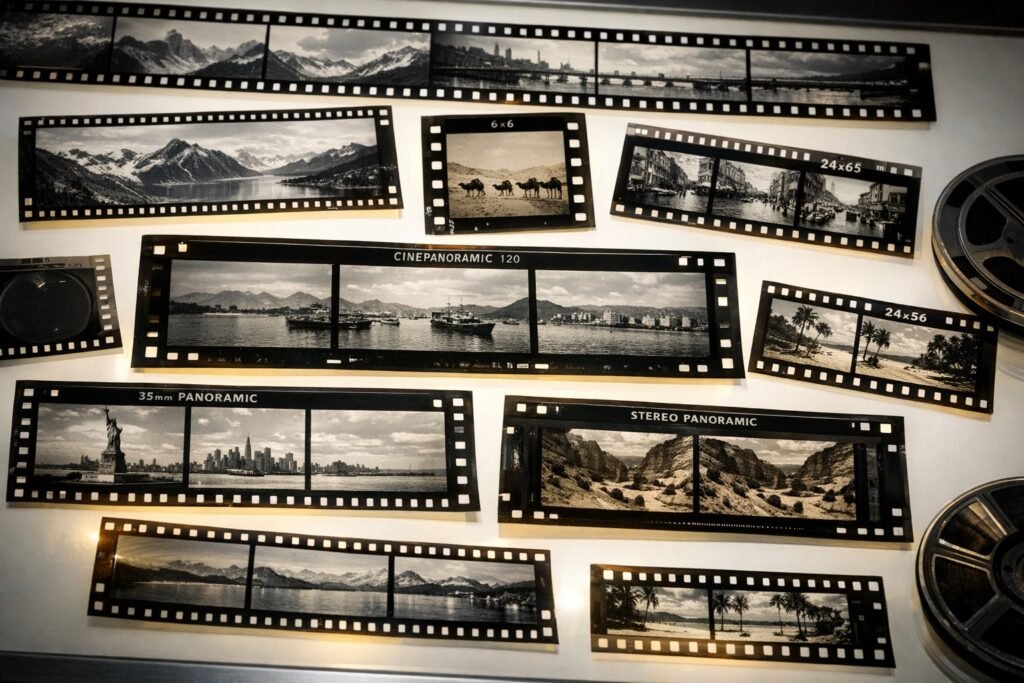
Panoramic photography has always been a conversation between technology and the horizon — a negotiation between what the world offers and what the camera can hold. Before digital stitching and sensor‑based panoramas, photographers relied on specialized panoramic film formats to stretch their vision across landscapes, coastlines, and city skylines. These early formats didn’t just widen the frame; they widened the way photographers understood place.
As someone who sees the world through a panoramic lens, I’ve always felt that film‑based panoramas carry a particular kind of atmosphere — a slow, deliberate spaciousness that mirrors the way we turn our heads across a scene. The early film formats that made wide‑format photography possible, and how they shaped the creative language of panography is felt today.
Why Panoramic Film Formats Emerged
Long before 35mm became the everyday standard, photographers were already pushing for wider negatives. The early panoramic cameras of the 19th century — rotating bodies, curved plates, and swing‑lens mechanisms — demanded film formats that could match their sweeping motion.
Panoramic film formats emerged because photographers needed:
- Longer exposures to capture wide scenes
- Curved or flexible film planes for distortion‑free images
- Extended negatives capable of holding detail across distance
- Mechanical compatibility with rotating or swing‑lens cameras
These formats were not just technical solutions; they were creative invitations. They encouraged photographers to think in arcs, sequences, and horizons.
The First Panoramic Negatives: Paper, Plates & Curved Surfaces
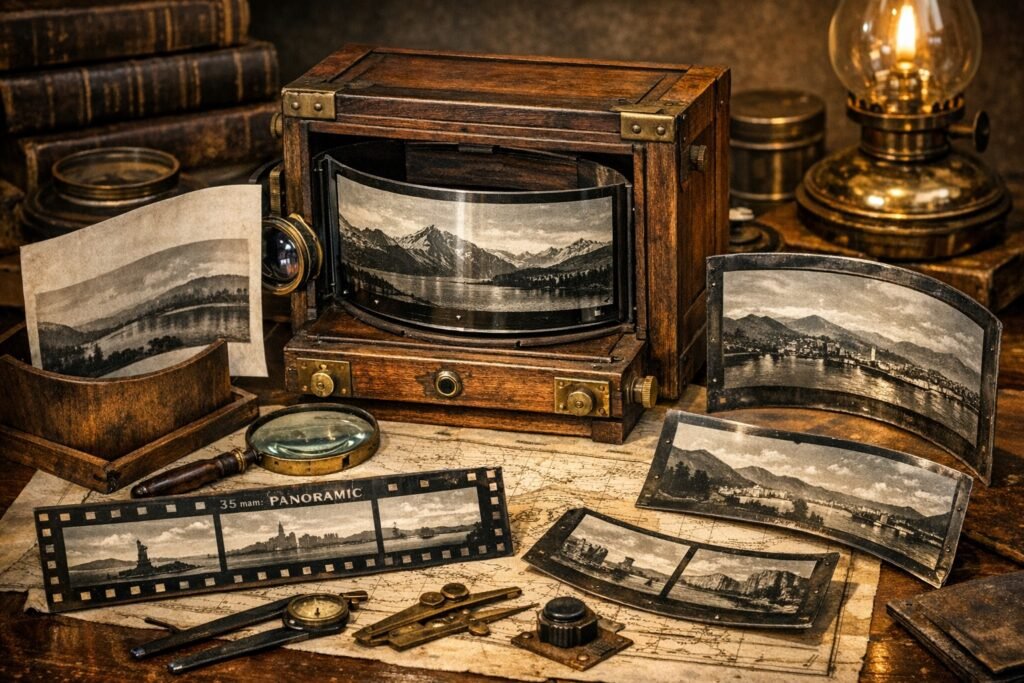
Before roll film, early panoramic cameras used curved plates coated with light‑sensitive chemistry. Thomas Sutton’s 1859 panoramic camera famously used a curved glass plate to match the optical path of his curved lens.
Why Curved Plates Mattered
- They prevented distortion across wide angles
- They allowed a single exposure to cover 120° or more
- They created seamless, immersive images
- They supported early scientific and topographical surveys
These plates were fragile, heavy, and difficult to prepare — but they produced panoramas with a clarity and presence that still feel modern.
The Rise of Roll Film: Flexibility Meets Wide‑Format Vision
When roll film arrived in the late 19th century, panoramic photography entered a new era. Flexible film allowed cameras to rotate smoothly, exposing long strips of negative without interruption.
Common Early Panoramic Film Widths
- 120 film (used in many swing‑lens and rotating cameras)
- 70mm film (favored for military and aerial panoramas)
- Specialized long-roll formats for survey cameras
- Custom widths for proprietary panoramic systems
These formats supported the mechanical revolution in panoramic cameras — from hand‑cranked rotating bodies to clockwork‑driven survey instruments.
Swing‑Lens Panoramic Film Formats
Swing‑lens cameras — descendants of Puchberger’s rotating design — used a moving lens that swept across the film plane. This required a curved film gate and a negative long enough to capture the full sweep.
Typical Swing‑Lens Negative Sizes
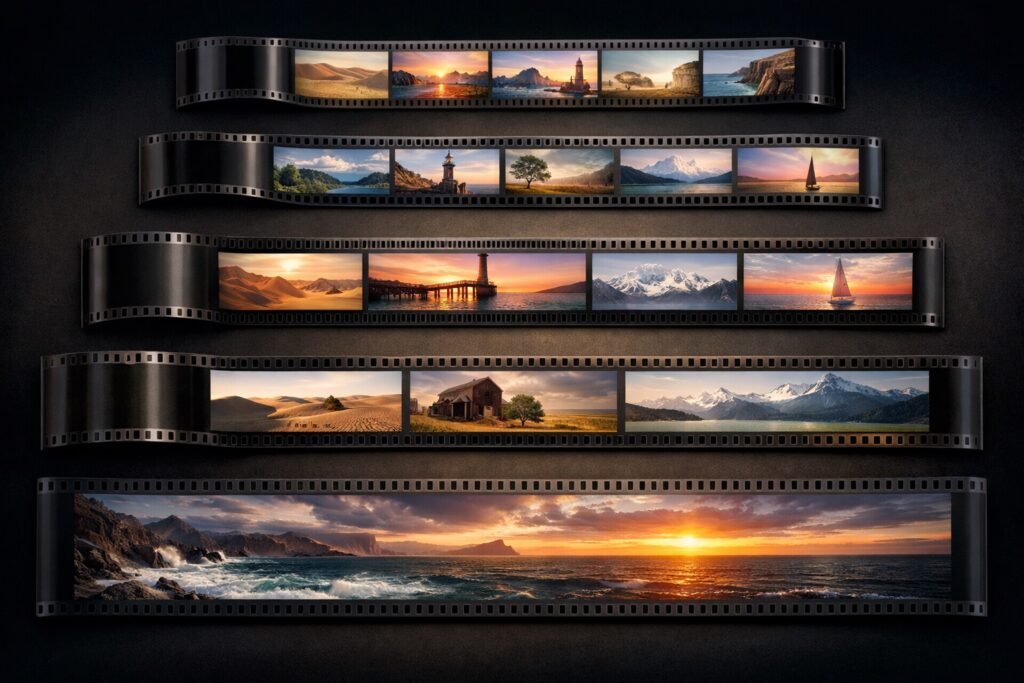
- 24×58mm (common in compact panoramic cameras)
- 24×65mm (a classic wide‑format ratio)
- 24×72mm (used in premium swing‑lens models)
- Medium‑format panoramic sizes such as 6×12, 6×17, and 6×24
These formats created the cinematic proportions that many panoramic photographers still love today — long, elegant frames that echo the shape of a horizon line.
Rotating Panoramic Film Formats
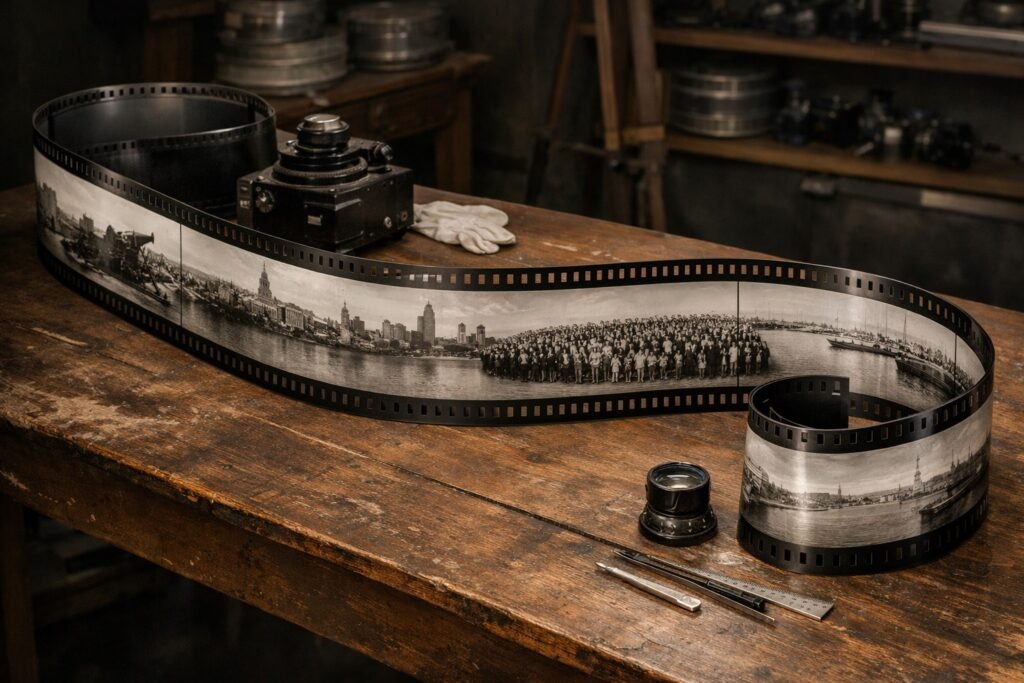
Rotating cameras exposed film through a narrow slit as the entire body turned. This produced extremely long negatives, sometimes several inches or even feet in length.
Why Rotating Formats Were Unique
- They captured 360° panoramas
- They produced negatives with consistent exposure across the sweep
- They were ideal for cityscapes, military documentation, and group portraits
- They created a sense of motion embedded in the image
These formats were the ancestors of modern cylindrical panoramas — the kind we now create with digital stitching or VR imaging.
Medium‑Format Panoramic Film: The Golden Ratio of Wide Photography
Medium‑format panoramic cameras became beloved tools for landscape photographers, travel artists, and environmental documentarians. Their film formats offered a balance of detail, dynamic range, and spacious composition.
Iconic Medium‑Format Panoramic Sizes
- 6×12 — a classic wide landscape ratio
- 6×17 — the cinematic standard for sweeping vistas
- 6×24 — ultra‑wide, immersive, and dramatic
These formats encouraged photographers to slow down, study the horizon, and compose with intention. When you look through a 6×17 ground glass, the world feels like a scroll — a continuous unfolding of place.
How Early Panoramic Film Formats Shaped Creative Vision
Wide‑format negatives changed the way photographers approached space. They encouraged:
- Environmental storytelling
- Layered compositions
- Attention to atmosphere and distance
- A deeper relationship with place
When you work with a long negative, you start noticing how landscapes breathe — how a coastline curves, how a mountain range stacks in tonal layers, how a city skyline stretches like a line of thought.
Panoramic film formats didn’t just widen the frame.
They widened the photographer.
Frequently Asked Questions
What was the earliest panoramic film format?
Early panoramic cameras used curved glass plates before flexible roll film became available, allowing wide scenes to be captured without distortion.
Why were panoramic negatives so long?
Rotating and swing‑lens cameras required extended film lengths to record the full sweep of the lens or camera body.
What film sizes were common in early panoramic cameras?
Formats ranged from 24×58mm swing‑lens negatives to large 6×17 and 6×24 medium‑format panoramas.
Did panoramic film formats influence modern digital panoramas?
Yes — today’s digital stitching and ultra‑wide sensors are direct descendants of the optical and mechanical principles established by early film formats.
Why do panoramic film images feel different from digital ones?
Film panoramas capture continuous motion and atmosphere across a single exposure, creating a sense of presence that digital stitching often smooths away.



Final Thoughts
Early panoramic film formats were more than technical solutions — they were creative frameworks that shaped how photographers understood the world. They taught us to slow down, to follow the horizon, and to see place as a continuous experience rather than a single moment.
When I work with panoramic film, I feel connected to the artists and engineers who first stretched the frame. Their innovations still echo in every wide‑format image we make today — from sweeping landscapes to immersive cityscapes, from museum exhibits to the quiet act of turning toward a distant horizon.